Buying a 3HK, CMHK, csl or Club Sim eSIM as a Visitor

Roami Team
Roami offers reliable eSIM plans, serving over 1 million travelers annually, and supports automatic local network switching to help travelers stay connected globally.
📑 Table of Contents
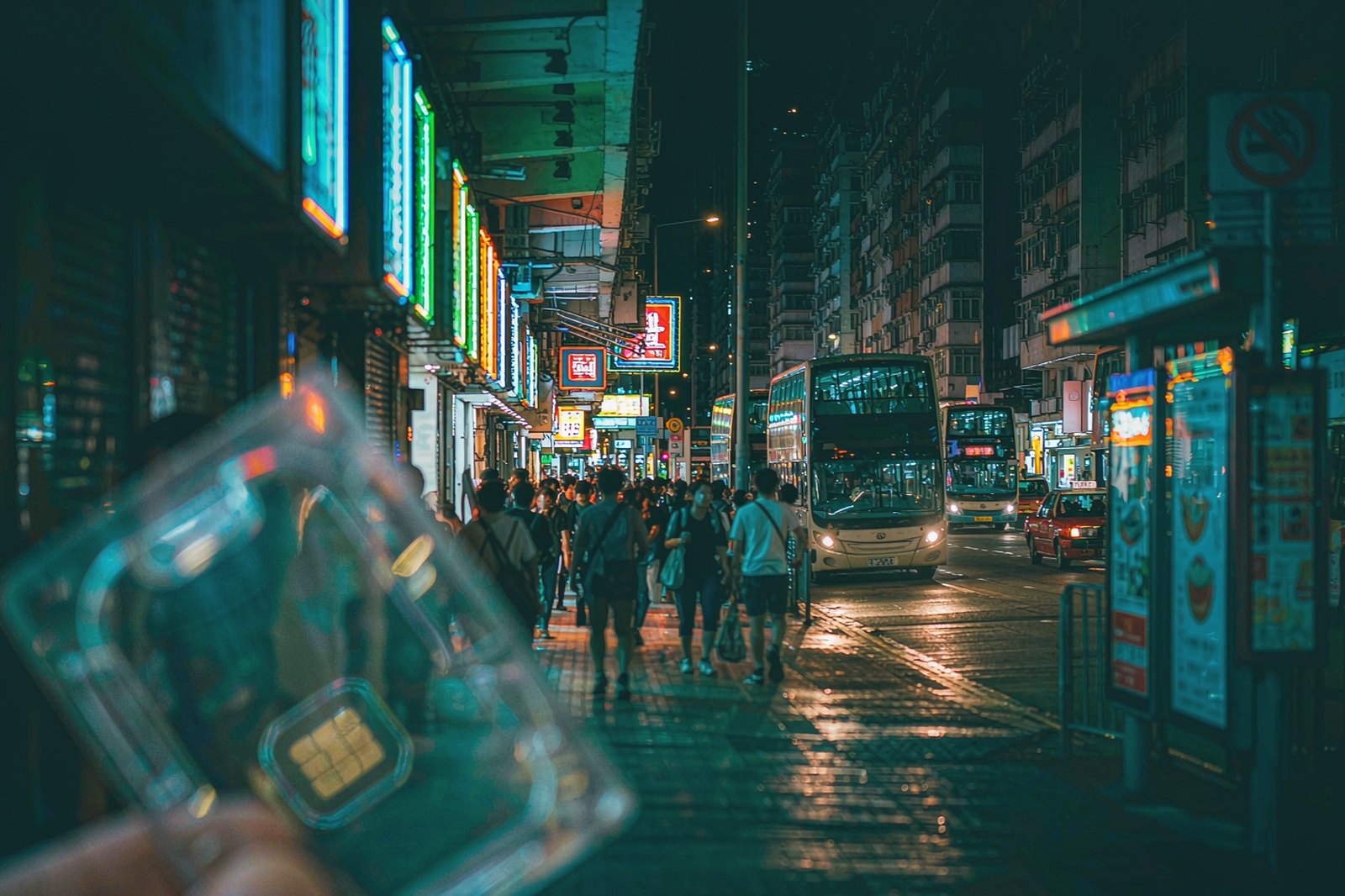
Buying a Hong Kong eSIM from a carrier is a different purchase from buying one from a travel provider, and the difference is not the data. It is the phone number.
A travel eSIM gives you a data allowance and nothing else. It cannot receive an SMS, so it cannot take a bank verification code, a delivery notification, or a call from a hotel front desk that does not use WhatsApp. A carrier-issued eSIM gives you a +852 number, local call minutes, and all of the above — in exchange for Hong Kong’s real-name registration process and a shopping trip to a counter or an app store page.
You have already decided the number is necessary. What follows is the buying side of it: what each of the four brands actually sells to a visitor, what it asks for at the counter, and where the process differs enough to change your choice. If you are not sure you need a number at all, most travellers do not, and the Hong Kong eSIM guide covers the data-only route that avoids registration entirely.
Network quality is a separate question with its own page. The Hong Kong carrier guide compares coverage, bands and measured speed across the same four networks, with a district-by-district walk-through. Start there if your decision turns on signal. This page turns on paperwork, queueing and what you walk out of the shop holding.
For the rest, here is who owns what, which brands get confused with the network itself, and which of the four is worth the trip.
Four Networks, Six Brand Names, One Confusing Market
Hong Kong has four mobile network operators. Between them they market at least six consumer brand names to prepaid buyers, which is why visitors often think there are more networks than there are.
| Network operator | Consumer brands | What the brand is for |
|---|---|---|
| Hutchison Telephone (3HK, also written 3 HK) | 3, 3HK, SoSIM | Prepaid data, budget entry tier, convenience store distribution |
| China Mobile Hong Kong (CMHK) | CMHK, U-Mobile | Aggressive prepaid pricing, mainland bundles |
| HKT (PCCW) | csl, 1O1O, Club Sim | csl for consumer, 1O1O for premium, Club Sim as the digital prepaid brand |
| SmarTone | SmarTone, Birdie | Reliability-first positioning, smaller tourist footprint |
The important consequence: a “cheap Hong Kong SIM” sold under a sub-brand is still riding one of these four networks. Quality differences between brands within one operator are about customer service, plan structure and throttling policy, not about signal.
Signal differences between the four operators are real, but they are location-specific rather than national. That is examined district by district further down.
One naming note that costs people time: the 3 HK eSIM and the 3HK eSIM are the same product. Hutchison’s own materials use both forms, and the spacing changes nothing about the network, the registration step or the plan. Comparing two listings where one says 3 HK and the other 3HK means you are looking at one operator twice.
3HK eSIM: Cheapest Entry, and What the Saving Costs You
Hutchison’s 3HK is the operator visitors encounter first, because its prepaid cards are the ones stocked in convenience stores and its eSIM can be bought through an app without a shop visit.
The pricing is the lowest of the four. SoSIM, the prepaid brand most associated with 3HK, is the card Hong Kong residents recommend to anyone staying a month, and the reason is straightforward value: a large local data allowance at a price that undercuts the other three.
What the saving buys in exchange is thinner coverage in specific places.
3HK’s network is strong across Hong Kong Island, Kowloon and the main New Territories towns. It is the operator most often reported as weaker inside older buildings in the New Territories, and in the far northwest near the mainland boundary. Spend the whole trip in Central, Tsim Sha Tsui and Causeway Bay, and you will not notice. Stay with family in Yuen Long, or work from an industrial building in Kwai Chung, and you might.
Two practical notes for the eSIM specifically:
- The eSIM is available as a prepaid product, which means registration is required before it activates. That is a passport scan through the operator’s app or at a shop.
- Topping up is easier than starting. Once the profile is live and registered, adding data is a few taps. The friction is entirely at the beginning.
If the only reason you are reading this is that you searched for 3HK eSIM pricing, the honest summary is: cheapest, works well in the places tourists go, and the weakest of the four in a specific set of residential districts.
Is SoSIM the same network as a 3HK eSIM?
Yes. SoSIM is a prepaid brand on Hutchison’s network, and a 3HK eSIM is the same network sold directly. The difference is distribution and plan structure, not signal.
SoSIM is bought as a physical card from a supermarket or convenience store, then activated and topped up through its app. A 3HK eSIM is issued digitally through the operator. Both end up on the same cells.
The practical implication: if you want the cheapest large allowance and are willing to walk into a supermarket on day one, SoSIM wins on price. Installing before you fly points at the digital 3HK product instead — and it still needs registration, which SoSIM also needs. There is no registration shortcut in either.
CMHK eSIM: The Mainland Bundle Is the Entire Point
China Mobile Hong Kong is the operator with the most obvious reason to exist for a certain kind of traveller: it is the one that makes crossing into mainland China simple.
CMHK sells packages that include mainland data, and as a subsidiary of China Mobile it has commercial arrangements that the other three do not. A trip covering Hong Kong plus Shenzhen, Guangzhou or Shanghai on one SIM is exactly what this operator’s catalogue is built for.
For pure Hong Kong use, CMHK competes on price and on 5G rollout speed rather than on coverage depth. Its prepaid pricing undercuts csl and SmarTone, and its 5G footprint in the urban core is broad.
The coverage profile that matters: CMHK is generally reported as strong in the urban core and on the MTR, with more variation in the outlying islands and country park edges than csl or SmarTone.
CMHK eSIM availability is broad, including prepaid products, which again means registration.
When CMHK is the right pick: your itinerary includes the mainland, or you want the lowest prepaid price with a usable 5G network in town.
When it is not: you are staying on an outlying island, or you need the best possible indoor signal in an old Kowloon building and are willing to pay for it.
Which mainland bundle actually includes data?
Not all CMHK products that mention the mainland include mainland data. Some are Hong Kong plans with discounted roaming rates; others bundle a real mainland allowance into the monthly or prepaid price.
The distinction shows up in three places on a product page: the words “mainland data” or “China data” in the allowance line, a stated gigabyte figure for the mainland separate from the Hong Kong figure, and a note about whether the mainland portion works on 4G only or also 5G.
If a plan says “roaming in China available” and nothing else, it is the first kind. It will connect, and it will bill you. The bundle you want names the gigabytes.
If you are doing a day trip to Shenzhen, the arithmetic usually favours a small mainland add-on over a full bundle. A three-day leg to Shanghai is where the bundle wins. The cross-border guide prices both shapes.
csl and 1O1O: The Coverage Premium, Priced Accordingly
csl is HKT’s consumer brand, and HKT’s network is the one residents describe as having the widest in-building coverage — the ability to hold a call inside a 40-year-old walk-up in Sham Shui Po, a basement restaurant in Mong Kok, or a car park on the Peak.
1O1O is the same network sold at a premium with concierge-style service. For a tourist, 1O1O is almost never worth the difference; for a resident who wants a single point of contact, it is the product they buy.
csl prices above 3HK and CMHK on prepaid. What you get for the difference is the indoor reliability and a network that holds up in dense old buildings, which is a real advantage if your accommodation is a boutique hotel carved out of a mid-century block rather than a tower with in-building antenna systems.
Practically, csl’s eSIM story for visitors is the weakest of the four on convenience: prepaid eSIM options exist but are narrower than the other operators’, and some products are structured around monthly plans rather than short visitor stays. Choosing csl specifically means visiting a shop — csl and 1O1O both run stores in the main shopping districts, and staff will complete registration and confirm data is working before you leave.
Check current prepaid and eSIM products on csl’s own site rather than relying on a comparison article, including this one.
Why a csl prepaid eSIM is harder to find
Because HKT’s prepaid strategy runs through Club Sim rather than through the csl brand.
csl is positioned for postpaid consumers and handsets; 1O1O for premium postpaid; Club Sim for prepaid and digital issuance. So a visitor asking “can I get a csl eSIM as a tourist” is pointed at a product that technically exists but is not the operator’s focus, while the Club Sim eSIM is the product actually built for that use case.
HKT network quality on a prepaid eSIM means asking for Club Sim. The csl brand specifically means a shop visit and a plan structure oriented to residents.
Club Sim and SoSIM: Two Prepaid Brands With Different Jobs
These two get confused constantly, so it is worth separating them.
Club Sim is a prepaid brand on the HKT network, sold through its own app and website. It is aimed at residents who want a digital-first prepaid line without a shop visit, and it offers eSIM issuance through the app. HKT coverage without a store queue is what Club Sim sells. The brand name appears written both as Club Sim and ClubSim, and the eSIM product is the same either way.
SoSIM is the value prepaid brand associated with 3HK. It is bought as a physical card from supermarkets and convenience stores, activated and topped up through an app, and it is the cheapest way to get a large local allowance in Hong Kong.
The distinction that matters for a visitor:
- Club Sim gives you HKT network quality with app-based issuance, which is the combination most useful for someone who wants coverage depth without visiting a shop. The Club Sim eSIM is issued entirely in the app.
- SoSIM gives you the lowest price per gigabyte, tied to 3HK’s network, and requires buying a physical card first.
Both require real-name registration. Both are local products with a +852 number. Neither is a travel eSIM, and neither is subject to the 24-hour email-support model that international providers use — you get a carrier hotline and, in SoSIM’s case, a supermarket receipt as part of your activation trail.
SmarTone: The Operator Locals Rate Highest and Tourists Miss
SmarTone is the smallest of the four in tourist visibility and the one residents praise most consistently for reliability. Its network is not the widest, but it is unusually consistent: fewer dropped calls, fewer dead spots in the places people actually live.
For a visitor, SmarTone’s weakness is distribution. There are fewer tourist SIM counters, fewer convenience store products, and a smaller eSIM prepaid range than 3HK or CMHK. You generally need a SmarTone shop.
Its strength appears in exactly the scenarios where the others get complaints: a long stay, a work trip with daily calls, a residential neighbourhood rather than a hotel district.
When SmarTone is worth the effort: stays over two weeks, or any trip where a dropped call has a cost.
When it is not: a three-day city break, where the difference between SmarTone and 3HK in Tsim Sha Tsui is close to unmeasurable.
Where SmarTone actually wins
The wins are consistent rather than spectacular: a call that does not drop walking from a lift lobby to a car park, a data session that survives a train tunnel, a signal that holds on the 20th floor of a residential tower.
Those sound like small things until you are on a work call that matters. SmarTone’s reputation among residents is built on the absence of annoyances rather than on peak speed, and for a visitor staying in a residential district or working across the territory, that is worth paying for.
It is not worth paying for on a three-day sightseeing trip in Tsim Sha Tsui, where every operator performs well and the difference is unmeasurable in practice.
What Registration Actually Asks of a Visitor
All four operators are bound by the same rule, so this section applies regardless of which one you pick.
Hong Kong’s real-name registration programme for SIM cards has been in force since the regulation took effect on 1 September 2021. New cards issued from 1 March 2022 must be registered before activation; existing prepaid cards that missed the 23 February 2023 deadline were deactivated. The Communications Authority’s registration page is the primary source.
For a visitor, the process is:
- Buy the card or eSIM from the operator.
- Open the operator’s registration link, app page, or complete it at the counter.
- Scan your passport photo page and confirm the details the system reads.
- Submit and wait for confirmation.
- Turn off Wi-Fi and test mobile data.
Four details cause most of the failures:
- Use the passport you entered on. A Hong Kong SAR passport and a BN(O) passport are not accepted for this process.
- Match the name exactly. Systems reject entries where the name is shortened or reordered relative to the passport.
- Each adult registers their own. A parent cannot register a card for an adult family member.
- The cap is 10 prepaid cards per operator per person. Irrelevant for most tourists, relevant if you are buying for a household.
Approval is usually immediate. Manual review happens when a scan is unclear, and it can take hours — which is why arriving at 11pm and buying at the counter is a worse plan than it looks.
Can you skip registration with a travel eSIM?
Yes, because a travel eSIM is not a Hong Kong-issued card. It is a roaming profile issued abroad, attaching to a local network as a visitor, with no local subscriber number. Registration attaches to the local number, so no number means no registration.
That is the entire trade: no registration, no number. You cannot have both.
When a Local eSIM Beats a Travel eSIM
The decision comes down to four conditions. Any one of them being true points to a local carrier product; none of them being true points to a travel eSIM.
| Condition | What it implies | Better choice |
|---|---|---|
| You need SMS from a bank, or local callbacks | A +852 number is mandatory | Local carrier eSIM |
| Stay is over two weeks | Per-day cost of a local prepaid plan wins | Local carrier eSIM, probably SoSIM or Club Sim |
| Your itinerary includes mainland China | A mainland bundle in one SIM removes a purchase | CMHK |
| You are staying in an outlying district long term | Coverage depth beats price | csl or SmarTone |
| None of the above | You need data, not a number | Travel eSIM, no registration |
The mid-case is worth naming because it traps people: a ten-day trip where you want a local number “just in case”. Registration costs an hour of your first evening and buys a number you will mostly not use. Buy the local product if you can name which service will text you. Unable to name it? Then you do not need it.
Thirty Days in Hong Kong, Costed Both Ways
Validity is where local prepaid and travel eSIMs diverge most, because the products are priced on different logic. Local prepaid is priced for residents who renew; travel eSIMs are priced for trips with an end date.
A 30-day local prepaid plan typically bundles a large local allowance with local call minutes, at a per-day cost that beats any travel product at that duration. That is the honest case for local: if you are genuinely staying a month, a carrier prepaid plan is cheaper per day and includes a number.
A 30-day travel product at $57.99 for unlimited, or $39.99 for 50 GB, is the right purchase in a narrower set of cases: you are staying a month but need no number, you want the profile installed before you fly, or you are moving between territories and want the plan in one app.
| Stay | Local prepaid, with number | Travel eSIM, data only | What decides it |
|---|---|---|---|
| 3 days | Registration overhead exceeds the benefit | 3 days 5 GB, $4.99 | Travel eSIM |
| 10 days | Workable but front-loaded with paperwork | 15 days 10 GB, $11.99 | Travel eSIM unless you need SMS |
| 30 days | Cheapest per day, includes calls | 30 days 50 GB, $39.99 | Local if you need the number, travel if you do not |
| 60 days plus | Clearly cheaper | Two 30-day purchases | Local |
The line is around two weeks. Below it, registration is a cost with no return. Above it, the per-day saving of a local plan starts to pay for the hour you spent registering.
Which Operator Is Actually at the Airport?
The arrivals hall at Chek Lap Kok is not a neutral marketplace. Three of the four operators have a counter presence, and the fourth mostly does not — which shapes what a tired traveller ends up buying at 11pm.
| Operator | Airport counter | Convenience stores | Practical availability |
|---|---|---|---|
| 3HK | Yes | Yes, including SoSIM | Easiest to buy anywhere |
| CMHK | Yes | Yes | Easy |
| csl | Yes | Limited prepaid range | Easy at the counter, thinner elsewhere |
| SmarTone | Limited or none | Rarely | Shop visit in town |
That distribution pattern explains a common experience: people arrive intending to buy one operator’s product and leave with another because only one counter was staffed.
Two things follow from it.
First, the airport is not where you exercise brand preference. If a specific operator matters to you, buy before you fly or visit a shop in town. Airport counters are for people who need data in the next fifteen minutes.
Second, airport pricing is not the same as city pricing. Counters price for convenience and for a captive audience with luggage. A convenience store card in Mong Kok is cheaper, and a pre-purchased travel eSIM is cheaper again for a short trip.
If your flight lands after midnight, treat the airport as a Wi-Fi source rather than a shop. Install before you fly and skip the question entirely — the install walkthrough covers the settings that matter once you are connected.
At the Counter: Ten Minutes, Five Steps
The counter process is quick, but it has an order, and getting the order wrong is what turns ten minutes into forty.
- Confirm the product is a prepaid tourist or data card, not a monthly contract. Contracts require a Hong Kong address and a credit check; prepaid does not. Asking for “prepaid” is enough.
- Hand over your passport before payment. Registration comes first for a new card. Staff scan the photo page and enter the details.
- Ask them to complete the registration while you wait, rather than sending you a link to do later. Counter staff have a registration channel that is faster than the public one.
- Have them insert the card and confirm data works, then run a speed test in front of them. This is the most useful thing a counter can do that a convenience store cannot.
- Photograph the packaging and the ICCID before you leave. If the line fails later, those two images are what support asks for.
Two questions worth asking at step 4: whether the plan includes tethering, and whether it includes any mainland or Macau data. Both answers are sometimes no, and both matter.
If you are buying an eSIM rather than a plastic card, step 4 changes: the staff member issues a QR code, you scan it, and they confirm the profile is active before you leave. Some csl outlets issue a physical activation kit with the QR printed on it, which is more reliable than photographing a screen.
When a Local eSIM Refuses to Activate
The failure modes for a carrier-issued eSIM are narrower than for international ones, because there is no territory confusion and no roaming question. They cluster in three places.
Registration has not cleared. The profile installs, shows no service, and the registration record is still pending. This is the most common cause and the least obvious, because the phone gives no hint. Check the operator’s app for the registration status before trying anything else.
The profile installed but the line is not selected. Same trap as any eSIM: the travel line is installed, the data line is still the home SIM. Settings, Cellular, Cellular Data, pick the local line.
The APN is wrong. Carrier-issued local eSIMs usually configure automatically, but occasionally they do not, particularly on imported handsets. The APN value comes from the operator’s support page; entering it manually fixes a connection that otherwise looks like a dead profile.
Two further checks worth doing in order: restart the phone once (this resolves a surprising share of activation stalls), and confirm the handset is not carrier-locked. A locked phone will accept the profile and refuse to register on the network — the device list and the iPhone model check cover the hardware side.
If none of that works, take it back to a shop. A carrier can re-issue a profile on the spot; an email queue cannot. This is the one genuine advantage of local products over travel eSIMs: the fix has a physical address.
Throttling: Which Operator Slows You Down First
Prepaid plans across all four operators are subject to fair-use policies, and the throttle threshold is where a cheap plan reveals itself.
| Plan type | Typical structure | What it feels like |
|---|---|---|
| Fixed-allowance prepaid | Full speed until the allowance ends, then stop | Predictable; the plan simply ends |
| “Unlimited” local prepaid | High-speed allowance, then reduced speed | Usually still usable for maps and messages |
| Tourist data card | Full speed for the validity period | Best experience, smallest allowance |
| Monthly contract | Large allowance, throttled after a soft cap | Not available to most visitors |
The variable that matters is the speed after the throttle. A plan that drops to a few hundred kilobits per second still loads map tiles and sends messages; one that drops to dial-up rates does not.
Practical advice: for a short trip, prefer a fixed-allowance tourist card over an unlimited local one. You know exactly when it ends, and you avoid the moment where the speed falls and you cannot tell whether the network is congested or the plan has been throttled.
For a long stay, the opposite holds: unlimited local prepaid at a throttled-but-usable speed is better than running out of a fixed allowance in week two.
Either way, check the throttle speed before buying, not after. It is usually in the fine print of the plan page rather than the headline.
One more throttle trap deserves naming: hotspot use. Several local unlimited plans allow tethering but count it against the same high-speed allowance, and some exclude it from the unlimited portion entirely. If you plan to run a laptop from your phone, ask specifically whether tethering is throttled separately, because the answer changes which plan you should buy.
Porting a Number In, Out, or Off Another Operator
Porting and converting are different operations and the failure modes do not overlap. Porting moves a number between accounts. Converting changes the physical form of a card on the same account. This section covers the first; the next one covers the second.
For a long stay, the number becomes the thing you care about, and the terms are worth knowing before you commit to a carrier.
Moving a number in to a Hong Kong prepaid plan from another Hong Kong operator is straightforward: you need the current account details and a registration record in your own name, and the receiving operator handles the transfer. This is how residents switch when a better plan appears.
Moving a number out is the same process in reverse, and it fails for one predictable reason: the number was registered to someone else. If a friend or a shop registered the card on your behalf, you cannot move it, because the account is not yours. This is the strongest argument for registering in your own name at the counter rather than letting a vendor do it as a favour.
Moving a foreign number onto a Hong Kong plan is not possible. A +1 or +44 number belongs to its home operator. What you can do is keep the foreign line active on your phone as a second SIM for incoming SMS while the Hong Kong line carries data — which is the arrangement most long-stay visitors end up using, and it costs nothing on the Hong Kong side.
One habit that prevents trouble: keep a photo of the registration confirmation and the ICCID. When a prepaid line stops working after months of inactivity, support asks for exactly those.
Where the Four Actually Diverge, Street by Street
In the tourist core they do not diverge at all. Central, Admiralty, Tsim Sha Tsui, Mong Kok and Causeway Bay are saturated by all four, and any ranking of them there is measuring congestion on the day you tested, not network quality. If that is your whole trip, network choice is the wrong thing to optimise — price and the number question matter more.
The divergence shows up in four specific settings, and these are the only ones worth buying for.
| Setting | What goes wrong | Which of the four holds |
|---|---|---|
| Sham Shui Po, older Kowloon walk-ups | Thick party walls, five or six floors of concrete between you and the street cell | csl and SmarTone, by a visible margin |
| Kwai Chung and Tsuen Wan industrial blocks | Mixed indoor performance; some blocks carry in-building antenna systems and some do not | SmarTone, then csl |
| Yuen Long, Tin Shui Wai, northwest New Territories | Coverage exists but cell spacing is wider than on the island | csl and CMHK |
| Lamma, Cheung Chau, Peng Chau | Ferry handover between island cells and harbour cells | csl and SmarTone report steadier |
The reason is spectrum, not marketing. The four hold different combinations of low-band, mid-band and millimetre-wave holdings, and low-band is what penetrates walls. An operator strong in mid-band can post the fastest speed test in an open street and still lose you inside a 1960s walk-up. That is why a coverage map shaded by district tells you almost nothing, and why the operator’s own indoor coverage tool is worth more than any comparison article.
Two settings sit outside this comparison. On the MTR, all four cover platforms, tunnels and moving trains, including the cross-harbour sections; the MTR’s coverage page lists which systems are live on which line. At Lok Ma Chau, Futian and Shenzhen Bay, Hong Kong signal simply ends at the boundary regardless of operator — that is a regulatory line, not a coverage gap, and only a mainland bundle crosses it.
District-by-district selection, including which network suits which area of a short trip, is covered in the wider planning guide. This page stays on the operator differences that survive once you have picked a district.
Converting a Plastic SIM to an eSIM at Each Operator
The physical-to-eSIM conversion keeps the number, keeps the account and keeps the plan. What changes is only the form the card takes, and how much paperwork it costs differs sharply by operator.
For a postpaid line, the swap is usually done in a shop or through the operator’s app: they issue a new eSIM profile, the physical card is deactivated, and the number moves across. There is often an administrative fee, and the amount varies by operator and by contract.
For a prepaid line, the swap depends on whether the operator supports prepaid eSIM issuance at all. Some do through the app; some require a shop visit; some do not support it for certain legacy products.
Two things go wrong:
- The old SIM stops working the moment the new profile activates. Do the swap when you have Wi-Fi and time, not in an airport queue.
- Repeated swaps are limited. Each conversion consumes a profile. Providers restrict how many times you can convert per period, so do not use “swap to eSIM” as a troubleshooting step.
If you are converting because you want to free the physical slot for a home SIM, check first that your phone supports dual eSIM rather than one eSIM plus one nano-SIM. The compatibility list covers which models do.
Does a Carrier eSIM Work in Macau and the Mainland?
Mostly no, and this is where local products disappoint people who expected more.
A Hong Kong carrier’s standard prepaid plan covers Hong Kong. Macau and mainland China are separate territories with separate networks. Crossing the boundary on a standard Hong Kong plan either stops data or starts roaming at a metered rate.
Two exceptions exist, and both have to be deliberately bought:
- Mainland bundles. CMHK and the others sell packages that add mainland data to a Hong Kong line. These are priced separately and have their own allowances.
- Greater Bay Area style packages. Combined Hong Kong, Macau and Guangdong products exist across the four operators, structured as add-ons or as dedicated plans.
If your trip is genuinely cross-border, buy the combined product up front rather than discovering the boundary. The three-territory guide covers the switching mechanics and which product shapes actually include which territory.
Seven Things People Ask About Hong Kong Carrier eSIMs
Which is better, 3HK or csl? 3HK is cheaper and fine in tourist districts. csl costs more and holds indoor signal better in old buildings. Pick by where you will sleep, not by which name you recognise.
Can I get a CMHK eSIM without visiting a shop? Prepaid issuance is app-based for several products, with registration completed through the app. Expect a passport scan and a wait for approval.
Is clubsim esim the same as csl? Club Sim runs on the HKT network, the same network as csl and 1O1O, but it is a separate prepaid brand with its own app and its own plan structure.
Do I need a Hong Kong ID to register? No. Visitors register with a passport or travel document. An HKID is used only if you have one.
Can I keep the number after I leave? A prepaid number stays alive as long as it is topped up within the operator’s validity window. Let it lapse and the number returns to the pool.
Will a local eSIM work in my phone if a travel eSIM would? Yes — the hardware requirement is identical. The difference is the registration step, not the technology.
Is a HK mobile eSIM from a carrier cheaper than a travel eSIM? Over a month, usually yes. Over a week, usually no, once you count the time spent registering and the fact that short-validity carrier products are limited.
Anyone who has read this far and concluded they want data without a number should start with the comparison of travel options covers that market properly. Wanting the number because a specific service will text you narrows the choice to csl for coverage, CMHK for the mainland bundle, and 3HK for price — and the registration hour is the price of admission for all three.