A Dutch Number on an eSIM, and What It Is For

Roami Team
Roami offers reliable eSIM plans, serving over 1 million travelers annually, and supports automatic local network switching to help travelers stay connected globally.
📑 Table of Contents
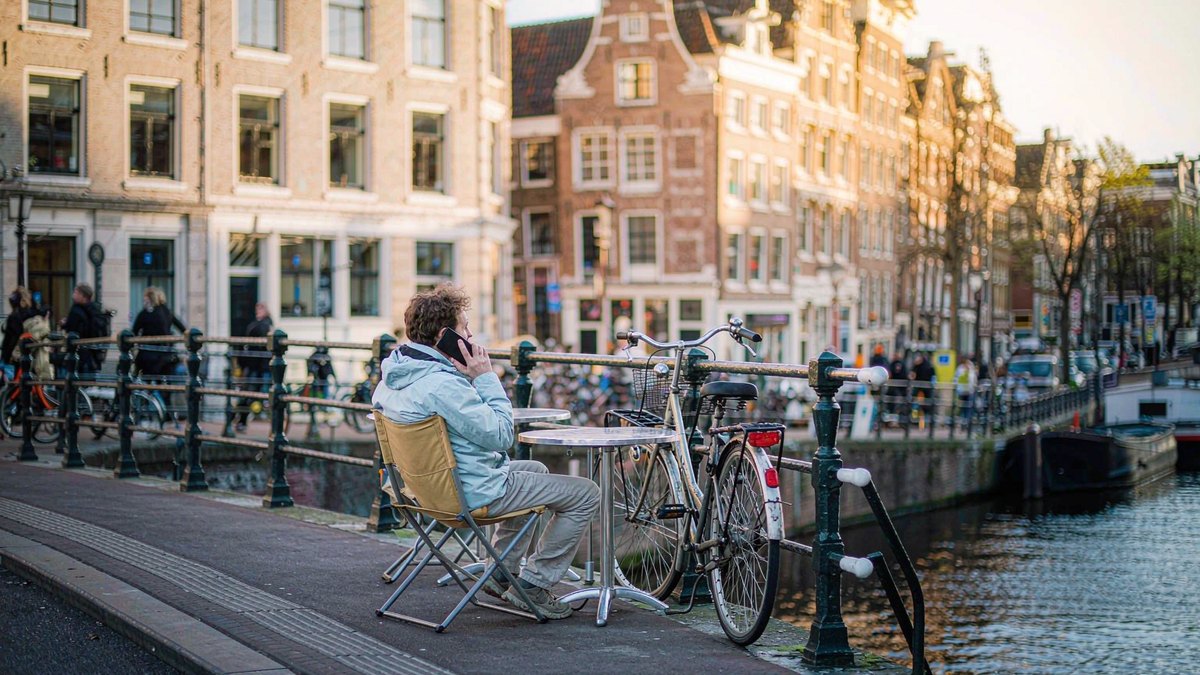
Every car hire desk, landlord and out-of-hours GP in the Netherlands works from the same assumption: that the number on your booking will ring. A data-only eSIM is the cheapest way to get online here and the fastest way to become unreachable, and the space between those two facts is what this page is about.
There is no registration requirement, so a Dutch number is roughly ten euros and fifteen minutes away. Almost nothing a tourist does needs one. Both statements are true, and together they explain why this particular ten euros is so often either skipped or wasted.
The distinction worth understanding is that a number and a data connection are two products sold by the same shop, and every international travel eSIM sells only the second. A data-only profile has no inbox, which means no bank code, no verification text and no missed-call notification from a car hire desk. That single fact causes more practical trouble in the Netherlands than coverage does, and it is fixable without buying anything.
This page covers what a +31 number is actually for, which Dutch products include one, what it cannot do, and how to arrange your two lines so the SMS you need arrives on the line that can receive it. The country mechanics are on the Netherlands eSIM guide; the pricing is on the prepaid cost breakdown; and which Dutch brand sells which product is on the network-by-brand breakdown.
Where it lands: buy a Dutch number if a person or an institution in the Netherlands has a reason to ring you — a car hire, an apartment, a landlord, a GP. Do not buy one for parking apps, public transport, museum tickets or restaurant bookings, because none of those need it. And whichever you choose, keep your home line active, because that is where your bank code has to land.
When a Dutch number earns its €10 and when it does not
Start with the cases where it does, because they are specific and they cluster around anything that involves a person waiting for you.
A car hire. Dutch rental desks increasingly want a reachable mobile number, and a delayed vehicle or a swapped car is communicated by phone, not email. A data-only eSIM gives the desk a number that cannot ring.
An apartment or a landlord. Key handover, a broken boiler, a neighbour with a complaint. If you are staying anywhere that is not a hotel with a 24-hour desk, a local number is the difference between solving a problem and being unreachable.
A GP or a pharmacy. Dutch huisartsenposten for out-of-hours care will want to call you back, and they are not going to call a US number at their expense.
Anything with a Dutch counter. A bike shop doing a repair, a luggage storage desk, a tour operator rescheduling because of weather.
Now the cases where it does not, and this list is longer than most guides admit.
Parking apps. EasyPark and Yellowbrick both accept foreign numbers. A Dutch number is not required to start a session, and the €85 to €90 municipal ticket you are avoiding does not care what number is on the account.
Public transport. The OVpay system taps a bank card or a phone at the gate. It needs no phone number at all, and the app that lets you correct a missed tap works with any email address.
Restaurants, museums and tickets. Bookings are online and confirmations are by email.
Your bank. This is the one people get backwards. A Dutch number does not help your bank reach you; it is the reason your bank cannot. More on that below.
A reasonable rule: if the trip is a hotel-based city break, skip the number. If the trip involves a vehicle, an apartment, or anything with a Dutch person expecting to reach you, buy one.
What a Dutch mobile number looks like: 06, +31 and the leading zero
The format trips up visitors constantly, and getting it wrong on a form is a small failure with a long tail.
A Dutch phone number for a mobile is ten digits and begins with 06. Written nationally it looks like 06 1234 5678. Written internationally the leading zero is dropped and the country code is added, so the same number becomes +31 6 1234 5678. That is the form a foreign phone dials, and it is the form that goes into an international booking form.
Two practical consequences.
If someone gives you a number starting 06 and you are dialling from a non-Dutch SIM, you must convert it to +31 6 and drop the zero. Dialling 06 from a foreign profile fails silently or reaches nothing.
If a Dutch website asks for a telefoonnummer and rejects +31, it usually wants the 06 form. The reverse is also common. Expect to try both.
The prefix structure is worth knowing because it tells you what kind of line you have been given. Mobile numbers sit in the 06 blocks, with 061 to 065 and 068 being the ordinary consumer mobile ranges. Numbers beginning 085 and 088 are national VoIP and corporate services, not mobile. Numbers beginning 0800 are freephone, 0900 and 0909 are premium rate, and 097 is used for machine-to-machine connections.
That distinction matters for one specific reason: an 085 VoIP number looks like a phone number, receives calls, and is rejected by a large share of SMS verification systems because it is not a mobile line. A cheap “Dutch number” sold as a VoIP service is not the same product as a Dutch mobile number, and the difference only shows up when a code fails to arrive.
The number and the data are two purchases, and only one is instant
Dutch carriers sell the line and the bundle separately, and the number comes with the line and not with the data.
Buy a starter pack and the number exists immediately, printed on the packaging or sent by SMS once the SIM connects. Buy a bundle and the data exists only after the activation step. So the sequence on arrival is: buy the pack, get a number, activate the bundle, get data. Skipping the third step leaves you with a working Dutch number on a pay-as-you-go rate of roughly €0.10 a megabyte.
For an eSIM bought from an international reseller the sequence collapses to nothing, because there is no number and the data activates on first connection, as the installation walkthrough describes. That is the trade in its cleanest form: a reseller sells you the part that works instantly and none of the part that needs a shop.
The practical implication for anyone who wants both is that they are not in conflict. A dual-SIM phone runs a data-only eSIM for connectivity and a Dutch prepaid line for the number, and the Dutch line never needs to carry data at all. That arrangement costs the price of a starter pack — roughly €10 to €15 — plus whatever small top-up keeps the line alive, and it removes the €0.10 risk entirely because the Dutch line is never the data line.
Which Dutch products actually include a number
The market splits cleanly, and the split is the most useful thing on this page.
| Product | Number included | Voice and SMS | Typical price | Activation step |
|---|---|---|---|---|
| Vodafone prepaid eSIM | Yes, +31 | Yes | Around €10 for 7 days, €15 for 14 | Bundle activation required |
| KPN prepaid eSIM and travel plan | Yes, +31 | Yes | From about €19.99 | Bundle activation required |
| Odido app-based visitor product | Yes, +31 | Yes | Varies by bundle | In-app purchase |
| Lebara and Lyca prepaid | Yes, +31 | Yes | From around €5 | Bundle activation required |
| Dutch supermarket starter pack | Yes, +31 | Yes | €10–15 | Bundle activation required |
| International travel eSIM | No | No | $2–36 | None |
The pattern is unambiguous. Every Dutch product has a number; no international reseller product does. There is no clever workaround and no reseller that quietly includes one — the +31 range is allocated by the Dutch regulator and a reseller has no way to hand you one.
What varies between the Dutch products is the bundle attached, the activation friction, and the top-up path. A supermarket starter pack is the cheapest number; a carrier eSIM bought online is the most convenient; an MVNO is the cheapest monthly cost and the thinnest support.
If what you actually want is a number and not a data plan, the cheapest correct purchase is a starter pack from a supermarket with a small top-up, used purely as a voice and SMS line alongside a data-only eSIM. That combination costs about €15 for a week and covers both halves of the problem, which no single product does.
What a +31 number opens up in day-to-day Dutch life
Concretely, and in rough order of how often it matters.
A call-back you did not schedule. The Dutch service economy runs on phone calls in a way that surprises visitors from countries where everything moved to chat. A bike repair, a restaurant table, a delivery — the default is to ring you.
A Dutch number on a form. Some municipal and commercial forms validate a Dutch format. Not many, and fewer every year, but they exist and they reject foreign numbers silently.
A local number for a local contact. If you are meeting a Dutch person, giving them a +31 number removes a small friction and a small cost from their side.
Two-factor codes from Dutch services. This is the one people overestimate. A Dutch mobile number will receive SMS from Dutch services, but the services that matter to a visitor — banks, government, insurers — are not ones you will be signing up to on a two-week trip.
Cheap calls within the Netherlands. Domestic calls are included in most prepaid bundles. If you need to ring a Dutch landline several times, that is a real saving against a foreign SIM’s international rate.
The Dutch habit of ringing instead of emailing
The reason a number matters more here than in, say, the UK or Australia is behavioural, not technical, and it is the part visitors underestimate.
Dutch service businesses default to the telephone. A bike repair shop will ring you when the repair is done rather than email. A restaurant will ring to confirm a larger table. A landlord will ring about the key. A delivery driver will ring because Dutch addresses are dense and doorbells are ambiguous. The country has excellent digital infrastructure and still runs its small transactions by voice, which is a combination that confuses visitors who equate good apps with asynchronous communication.
Three specific places this shows up.
Healthcare. The huisartsenpost — the out-of-hours GP service — works by phone triage. You ring, a triage nurse assesses you, and you are called back or given an appointment. There is no walk-in equivalent for most complaints, and the call-back requires a number that rings. This is the single strongest argument for a Dutch number on any trip longer than a fortnight, and it is invisible until someone in the party is ill.
Transport and delivery. NS customer service, airline rebooking desks and courier firms all escalate to a phone call when an app fails. A foreign number in a booking record is frequently not dialled at all.
Anything municipal. A gemeente office corresponding about a permit, a parking fine appeal or a registration will use post and phone, not email.
None of this makes a Dutch number mandatory. What it does is explain why Dutch travel advice so often says get a local SIM — the advice was written by people who live in a country where the phone still works as the primary channel. The honest translation for a visitor is narrower: buy the number if your trip has a person in it who may need to reach you, and skip it for a hotel-based city break.
What a Dutch number cannot get you: DigiD, iDEAL and your bank
What it does not get you is worth stating as plainly as what it does, because the marketing around local numbers implies a wider set of doors than it opens.
Three specific things that a +31 number will not get you, and one of them is the reason people buy the number in the first place.
DigiD is the Dutch government digital identity system, and it requires a Dutch citizen service number as well as a registration. A phone number is neither necessary nor sufficient. If a website tells you to log in with DigiD, a Dutch SIM will not help.
iDEAL settles payments through Dutch bank accounts. It is not phone-based and a number does not affect it. If a top-up flow offers only iDEAL, the blocker is the bank account rather than the phone.
Your own bank is the important one. A Dutch number does not make your home bank able to reach you — it makes them less able to, because if you remove your home SIM to make room for the Dutch one, the code your bank sends goes to a line that is no longer in the phone.
This is the failure that catches people on day two of a trip. The fix costs nothing and has to be set up before departure: keep the home line active in the second slot with data roaming switched off, and turn on Wi-Fi calling for it. Texts arrive over the Dutch network at no data cost, and the two-factor flow keeps working. The device compatibility guide covers which handsets handle two active lines and which restrict voice to the primary slot.
The honest summary is that a Dutch number solves a Dutch person’s problem, not a bank’s problem. Buy it for the car hire, not for the SMS code.
Why 085 VoIP numbers get rejected by verification systems
A cheap Dutch number from a VoIP provider is an attractive-looking shortcut and it fails at exactly the moment you needed it.
Numbers in the 085 range are allocated for VoIP services, not mobile. They can receive calls, they can be dialled internationally, and they look completely normal on a business card. What they frequently cannot do is receive an SMS, because SMS routing to VoIP ranges is not guaranteed and many verification platforms refuse to send to them at all.
SMS verification systems increasingly check the number type rather than just the number. A mobile range passes; a VoIP range is treated as a higher-fraud channel and either declines to send or sends and never arrives. From the user’s side both look identical: the code never comes.
So a VoIP number is fine for a Dutch person to ring you on and useless for anything that wants to text you a code. If a provider is selling a Dutch number for a couple of euros a month with no SIM involved, that is what you are buying.
The mobile ranges — 06 with 1 to 5 or 8 in the next position — are the ones that receive SMS reliably, and they come from a carrier with a SIM or an eSIM attached rather than from a VoIP account.
Calling home from a Dutch number
The rates are less alarming than visitors expect, for two reasons.
EU roaming covers the Netherlands entirely if your number is Dutch. A Dutch prepaid bundle used in Belgium, Germany or France runs at domestic rates under roam like at home. So a Dutch number bought in Amsterdam keeps working across a multi-country trip, which is a genuine advantage over a country-locked travel eSIM.
Calling outside the EU is where the money goes. A Dutch prepaid bundle typically includes domestic calls and SMS and prices international calls separately, sometimes in the tens of cents per minute. If you need to ring the US, Canada or Asia regularly, check the international rate rather than assuming the bundle covers it, because it usually does not.
Receiving calls is normally free within the EU. So a Dutch number is a good thing to give out, even if you never dial from it.
The practical setup for a long stay: Dutch number for anything local, a data-only eSIM or the Dutch bundle for connectivity, and a messaging app for everything international. That combination keeps the phone bill in single-digit euros per week and keeps the two-factor codes arriving on the line that can receive them.
The two-line setup, step by step
Running a Dutch number and a home line at the same time is a settings exercise, and the order matters more than the individual toggles.
Install the Dutch profile on Wi-Fi at home, then leave it switched off. Both the physical SIM and eSIM routes work; what matters is that the Dutch line is present in the phone before you fly so the airport is not the place you are learning the menus.
Label both lines. iOS and most Android builds let you rename them — Home and Netherlands, or Work and NL. Unlabelled lines turn every subsequent setting into a guess.
Set the Dutch line as the default for mobile data. This is the setting that decides whether you are paying €5 a gigabyte or your home operator’s roaming rate.
Set the home line as the default for voice, or leave it on ask-every-time. A Dutch prepaid number is fine for local calls and expensive for international ones, so most people keep home as the default for calls and use the Dutch line only when they are dialling a Dutch number.
Turn data roaming off on the home line, and leave roaming on for the Dutch line. This combination is the one that prevents the classic hundred-dollar surprise, where a phone routes a few megabytes through the home profile while it works out which line has signal.
Switch on Wi-Fi calling for the home line. This is what keeps SMS codes arriving when the home network’s signal is absent. It can be enabled from home, and it is much harder to enable once abroad.
Check which line receives SMS on Android. Some builds route texts to the default SMS SIM only. If a code is not arriving, this is the first setting to look at rather than the last.
Two failure modes are worth knowing in advance. On some Android handsets, voice over LTE is restricted to the primary slot, so the Dutch line gets data while the home line quietly loses the ability to make calls — usually the reverse of what was wanted. And on an eSIM-only iPhone, two active eSIMs are the only configuration available, which works but leaves no physical slot for a borrowed local SIM. The handset compatibility page covers which devices restrict voice to the primary slot and which do not.
Keeping a Dutch number alive between trips
A Dutch prepaid line is not a subscription, so it survives only as long as it is used. The mechanism differs by carrier but the shape is consistent: after a period of inactivity, typically measured in months, the line is suspended and eventually the number is recycled.
Two ways to keep it.
A small top-up on a schedule. A few euros every few months, redeemed with a voucher or a card, resets the inactivity clock. This is the cheapest method and it requires nothing more than a calendar reminder.
Keep the bundle renewing at the smallest tier. More expensive and more reliable, and it means the line is genuinely active rather than merely alive.
Whether it is worth it depends on how often you come back. For an annual visit, the cost of keeping a line alive approaches the cost of a new starter pack each time, so the argument is weak unless the number has been given to people who will use it. For anyone in the Netherlands several times a year, or with a Dutch landlord or employer, keeping the number is obviously right.
One warning worth having: a recycled number can be reassigned to a stranger, and any account still pointing at it becomes theirs to receive. If you have given a Dutch number to a service that sends codes, keep the line alive or change the number on the account before you stop topping it up.
What a Dutch number costs over a year
The arithmetic for keeping a line is less obvious than the arithmetic for buying one, because the costs are small and scattered.
| Approach | Over twelve months | What you get |
|---|---|---|
| New starter pack each visit, three visits | €36–45 | A different number every time, no continuity |
| One line kept alive with a €10 top-up every four months | Around €30 | The same number all year, ready on landing |
| One line with a small bundle renewing | €60–90 | Always active, data included, the most expensive way to keep a number |
| VoIP number from a provider | €24–60 | A number that cannot reliably receive SMS |
The middle option is the one most people want and the one least advertised, because it is not a product anybody sells — it is a behaviour. A €10 voucher every four months, redeemed from anywhere, keeps a Dutch prepaid line alive for about the price of one starter pack, and it means the number on your car hire booking next year is still yours.
Whether that is worth €30 depends entirely on whether anyone will ring it. For a number given to a landlord, an employer or a letting agency, it is obviously worth it. For a number used once to receive a parking app’s verification text, it is not, and a fresh starter pack each visit costs about the same.
What changes at three months, and why the number stops being the problem
There is a threshold in a Dutch stay where the phone number stops being the hard part and the administration starts. It sits somewhere around the three-month mark, and it is worth knowing what is coming because the sequence is fixed.
A BSN. The citizen service number comes from registering at a gemeente, which requires an address. Without it you cannot open a bank account, sign most contracts, or use any government service. A prepaid phone number does not require a BSN, which is exactly why visitors can buy one on day one and residents cannot buy anything else.
A Dutch bank account. This requires identification and normally a BSN. It is the gateway to iDEAL, which is the gateway to paying a Dutch mobile contract by direct debit. Until you have it, prepaid remains the only practical way to hold a Dutch number.
DigiD. The DigiD system is the government’s digital identity and it needs the BSN. It is not phone-based, so a Dutch number does not help you get one, and it does not replace one.
A Dutch mobile contract. Once you have a BSN and a Dutch bank, a monthly contract becomes available and it is cheaper per gigabyte than prepaid. The number can be ported from your prepaid line, which is the point at which the prepaid number you kept alive for a year turns out to have been worth keeping.
The implication for anyone planning a long stay is that the prepaid number is a bridge rather than a destination. It costs a few euros a month, it works from the day you land, and it holds your number until the administrative pieces arrive. The government services portal sets out the registration sequence if you are starting from nothing.
What does not change at any point is the data problem. A prepaid bundle bought at a supermarket is a perfectly good long-term data product, and plenty of residents keep one alongside a contract number because the bundle pricing is competitive for heavy use.
Porting a Dutch number to a new phone or carrier
Two different operations get called porting, and only one of them is possible on eSIM.
Moving to a new phone. On a physical SIM, this is free and instant — take the card out and put it in the other handset. On an eSIM it is a carrier reissue, which on prepaid may not be offered at all. This is the single strongest argument for plastic if the number matters to you.
Switching carriers. Dutch number portability is standard and takes a few working days, with a code from your current carrier. It is not something a visitor will do, but it is worth knowing that a Dutch number is genuinely yours rather than rented from the network.
For a trip, the practical consequence is simple: if the number is going to be load-bearing — a car hire, a lease, a job — buy the physical version, because it survives a lost or broken phone and an eSIM does not. If the number is a convenience, an eSIM is fine.
The Dutch numbers you may actually dial
A short list, because a phone full of Dutch numbers is more useful than a phone full of Dutch apps.
112 is the emergency number and it works from any handset with any network’s signal, with no SIM, no credit and no active bundle. The national emergency service is the number that matters on the Veluwe, in the dunes and anywhere the signal is thin, because emergency calls are not gated by your subscription.
0900-8844 is the police non-emergency line.
144 is the animal emergency line, which is more relevant than it sounds on a cycling holiday.
113 is the suicide prevention line.
116 000 is the missing children hotline, part of the EU-wide number.
Carrier customer service numbers are usually short codes or 0900 numbers printed on the packaging, and they are frequently chargeable. A prepaid line’s balance check is usually a USSD string rather than a call, which costs nothing.
Two trips the number saved, and one it did not
Abstract advice is easy to nod at and hard to apply, so here are the three scenarios that come up most often. Only two of them are solved by buying something.
The delayed rental car. A family lands at Schiphol, collects a car, and the desk discovers the booked category is unavailable and offers an upgrade requiring a call back in an hour. With a data-only eSIM the number on the booking is a foreign one that will not ring, and the family discovers the substitution at the counter instead of by phone. With a €10 Dutch starter pack, the call arrives.
The apartment key. A couple arrives at an Utrecht apartment at 20:00 and the key safe code does not work. The host’s number is a Dutch mobile. A data-only eSIM lets them message through an app if the host uses one; a Dutch number lets them ring, which is what the host expects. The difference is ten minutes versus an hour on a doorstep.
The bank code. A traveller swaps the home SIM out to make room for the Dutch one, and on day two the bank wants a code. The Dutch line is data-only and cannot receive it. Nothing about the Dutch number caused this — the removal of the home line did — and the fix was a setting rather than a purchase.
Two of those three are solved by a number and one is solved by leaving your home line alone. That ratio is roughly right for the Netherlands.
Four travellers, four numbers, or one number and three data plans
Groups overthink this. The question is not how many people are travelling, it is how many people anybody might need to ring.
| Configuration | Cost for a week | When it is right |
|---|---|---|
| Four Dutch starter packs with bundles | €48–60 | A family where the teenagers split off during the day |
| One Dutch number plus three data eSIMs | €12 plus $24, so about €34 | Most families; one adult carries the reachable number |
| Two Dutch numbers plus two data eSIMs | €24 plus $16, so about €38 | Two couples travelling together, or two adults who separate |
| Four data eSIMs, no numbers | $32, so about €30 | A hotel-based city break where nothing needs to ring |
The middle row is the configuration that wins most often, and the reasoning is worth spelling out because it inverts the instinct to get everyone a local SIM.
A Dutch number exists so that a Dutch person can reach your group. One working number satisfies that requirement completely — the car hire has a contact, the landlord has a contact, the GP has a contact. The other three travellers need data, not numbers, and a data-only eSIM is cheaper, activates instantly, needs no shop and has no €0.10 pay-as-you-go risk.
The exception is the family whose teenagers go off independently and might need to ring home from a Dutch number, or a group where two people are on separate itineraries for part of the week. In those cases a second Dutch number is worth €12, and beyond two it rarely is.
One habit makes the one-number arrangement work: the person holding the Dutch number keeps their phone charged and their home line active, because they are now the group’s only inbound channel. A dead battery on that phone is a group-wide communications failure, which is a fair argument for a power bank in the day bag.
Questions people ask after buying a number
Does any international provider sell a Netherlands eSIM with a phone number? Not from the resellers. The +31 range is allocated by the Dutch regulator to licensed carriers, so a number comes with a Dutch carrier product rather than with a travel eSIM.
How much does a Dutch number cost? Effectively the price of a prepaid starter pack, about €10 to €15 in a city supermarket and more at the airport, plus a small top-up to keep it alive. There is no separate line rental on prepaid.
Do I need a Dutch number for parking apps? No. EasyPark and Yellowbrick accept foreign numbers. What you need is working data at the moment you park.
Do I need one for public transport? No. OVpay taps a bank card or a phone and needs no number, and the app that corrects a missed tap works with an email address.
Can I get a Netherlands eSIM with phone number included? Yes, from a Dutch carrier rather than an international reseller. Vodafone, KPN, Odido and the MVNOs all include a +31 number with a prepaid eSIM; no travel eSIM does.
Will a Dutch number let me use DigiD? No. DigiD requires a Dutch citizen service number and registration. A phone number is neither necessary nor sufficient.
Why does my Dutch number not receive SMS? If it begins 085 or 088 it is a VoIP number rather than a mobile, and many verification systems refuse to send to those ranges. A 06 mobile number receives texts reliably.
Can I keep my Dutch number after I leave? Yes, if you keep the line active with an occasional top-up. Numbers are recycled after a long period of inactivity.
Can I move a Dutch eSIM number to a new phone? Only through a carrier reissue, which prepaid may not offer. If the number matters, buy the physical SIM, because the card moves between handsets freely.
Does a Dutch number work in Belgium and Germany? Yes, under EU roam like at home at domestic rates, so a Dutch line bought in Amsterdam keeps working across a multi-country trip.
What if I only need a number and no data? Buy the cheapest supermarket starter pack and run it as a voice and SMS line alongside a data-only eSIM. That combination costs about €15 and covers both needs better than any single product.
The decision reduces to one question: does anyone in the Netherlands need to reach you? If yes, buy the number and consider buying it in plastic, because the card survives a lost handset and the profile does not. If no, spend the money on data instead and leave your home line active, so the codes still arrive on the line that can receive them. Either way, the ten minutes you spend labelling the two lines before you fly is worth more than the ten euros you spend on the number.